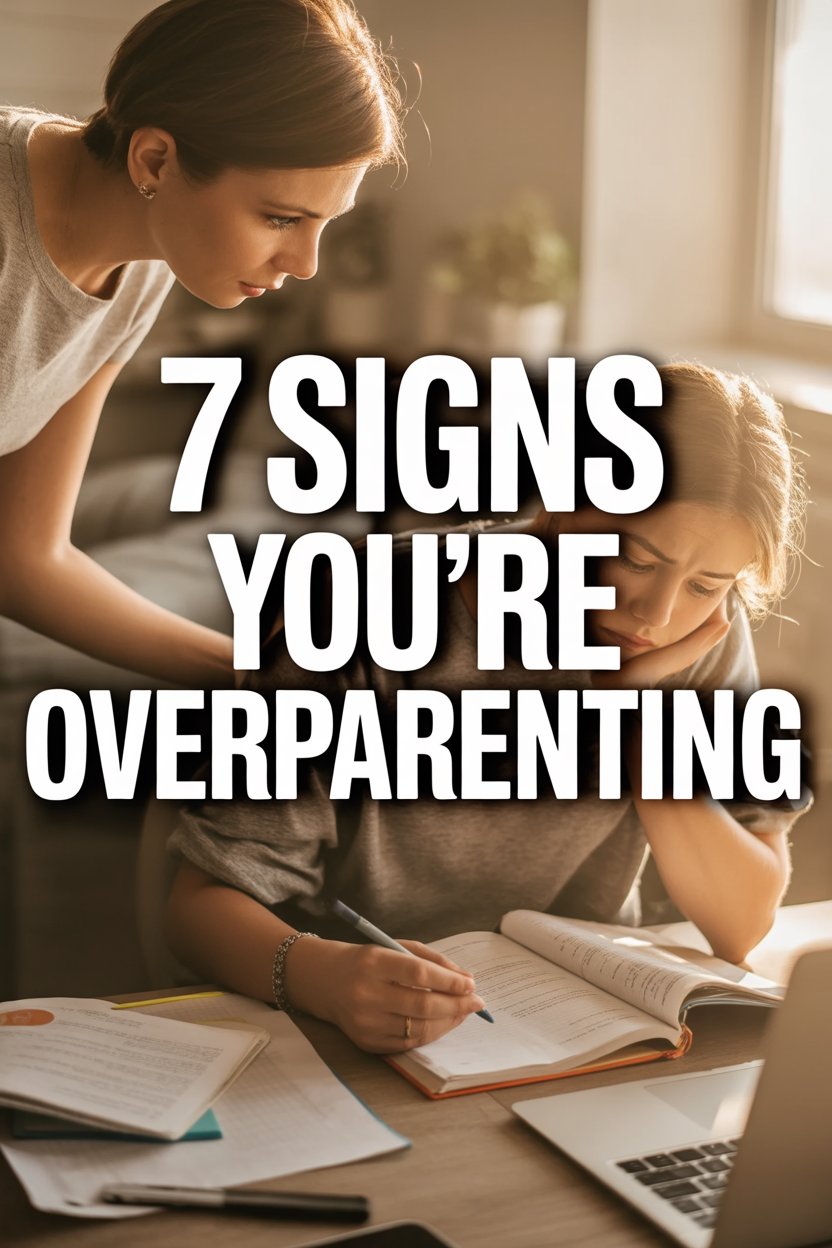
If you’ve ever hovered over your child’s shoulder, silently mouthing the words as they answer their teacher’s question on Zoom, you’re in good company. Most parents have had that “Am I doing too much?” moment.
The thing is, there’s a fine line between nurturing and smothering—one minute you’re being helpful, the next you’re the helicopter circling the playground.
Ready to spot the warning lights? Here are seven unmistakable signs your (well-meaning) overparenting might need a little tune-up.
1. You’re Their Personal PA—And You’re Not Getting Paid
Forgetting their football boots. Leaving their maths worksheet under the bed. These are the everyday dramas of childhood.
But if you’re forever ferrying forgotten items to school, emailing teachers for them, or filling out every administrative form before they can even blink, you’re playing the role of unpaid personal assistant.
Research has shown that when parents rescue kids from every lapse, children miss out on essential lessons in responsibility and resilience. Mistakes sting, but they’re fantastic teachers.
Forgetting a lunchbox once won’t end their education—it might just help them remember it next time.
Try sitting on your hands (literally, if need be) and letting them deal with minor consequences. You might be surprised by how quickly they adapt when Mum or Dad isn’t always there to save the day.
2. “We” Have a Science Project
When your child’s school project begins to look suspiciously like it was designed by a professional architect—and smells a bit like your late-night coffee—it might be time for a reality check.
If phrases like “we have a spelling test” or “our dance recital is next week” slip out of your mouth, you might be living vicariously through your child.
Kids who aren’t allowed to own their successes (and flops) can become anxious or self-doubting.
An enlightening study from the University of Washington reminds us that autonomy supports self-esteem far more than a shiny project ever could.
Cheer from the sidelines. Offer supplies. But let them glue their own fingers together for once.
3. You Micromanage Their Friendships Like an HR Executive
Do you find yourself arranging every playdate, monitoring every WhatsApp group, or intercepting minor playground squabbles like the world’s tiniest United Nations diplomat?
If the answer’s yes, it’s time to step back.
Childhood social life is messy by design. Sure, they’ll fall out. They’ll make up. They’ll ignore each other over a biscuit—and yes, sometimes the biscuit in question will cost you £3 and your remaining patience.
Research in the Journal of Child Psychology and Psychiatry suggests kids need a bit of social messiness to learn negotiation, empathy, and resilience.
Hovering nearby with a conflict-resolution manual isn’t just exhausting; it robs them of real-world practice.
Keep snacks on hand (for yourself) and resist the urge to intervene at every “She said–He said.” Trust your child to sort it more often than you think.
4. You’re Constantly Prepping for Worst-Case Scenarios
Every scraped knee gets a full health assessment. The playground slide? Too fast. The chicken at dinner? Practically a biohazard.
If your Google search history looks like “can you die from…,” you might be parenting from a place of fear.
Anxious overprotection, while well-intentioned, can backfire.
The American Academy of Pediatrics warns that excessive safety controls can foster anxiety in children, making them wary of new experiences.
Instead, teach them how to spot genuine risks and trust their instincts. They’ll learn to tell the difference between “real danger” and “Mum’s just had too much coffee again.”
5. You’re The Homework Police—With Sirens Blazing
If your evening routine involves sitting beside your child, correcting every equation, and reciting spelling words until someone cries (usually you), your helpfulness may be doing more harm than good.
Constant supervision tells kids you don’t trust them to manage on their own.
A fascinating report from the Harvard Family Research Project found that students thrive in environments where parents offer support but don’t micromanage.
Kids need space to get things wrong and figure out what works for them.
Pour yourself a cuppa, set a timer, and resist intervening unless they ask for help. It’s their learning journey, after all—you’ve already survived Year 6 maths.
6. You Negotiate Every Disappointment Away
Did your child miss out on a birthday invite? Didn’t get chosen for the football team? Is the ice cream shop closed, and the world as they know it has crumbled?
If your instinct is to swoop in with solutions, distractions, or a personal phone call to the coach, it’s worth pausing.
Shielding kids from all disappointment is a kindness that quickly wears thin. Life is full of “nos,” and learning to handle them is as important as learning to tie shoelaces.
Child psychologist Dr. Lisa Damour writes that resilience grows from facing disappointment, not running from it. Sometimes a cuddle and “that stinks” is the best medicine you can give.
Let some disappointments stand. Stock up on plasters, both physical and emotional—the world’s full of scrapes, but kids are wonderfully bandage-resistant.
7. Your Calendar Looks Busier Than Heathrow on a Bank Holiday
Football, piano, Mandarin, fencing, drama, coding, pottery… and that’s just Tuesday. If your family schedule requires military-grade logistics, you may be orchestrating more than your child can comfortably handle.
Overscheduling, even with the best intentions, can lead to burned-out kids and frazzled parents. The American Academy of Pediatrics advises that unstructured free time is critical for development, creativity, and mental health.
Try leaving some blank space on the calendar. Boredom is a creative incubator, not a crisis. Oddly enough, it’s where the best cardboard-box castles and kitchen-drum symphonies are born.
When Too Much Love Needs a Little Less “Much”
Most of us overparent out of love, not control. It’s easy to confuse involvement with support, or protection with preparation.
The trick is to know when to step aside—fingers crossed, heart in mouth, snacks at the ready—and let children try, wobble, fail, and soar.
Next time you’re tempted to swoop, pause. Breathe. Hand over the glue stick, let them forget their lunchbox, or allow a little boredom to settle in.
The results might just surprise you—and your kids will thank you (eventually, possibly in 20 years, probably in a therapist’s office, but hey, it still counts).
Here’s to loving with a lighter touch. Your children are more capable than you think—and frankly, you deserve a breather.