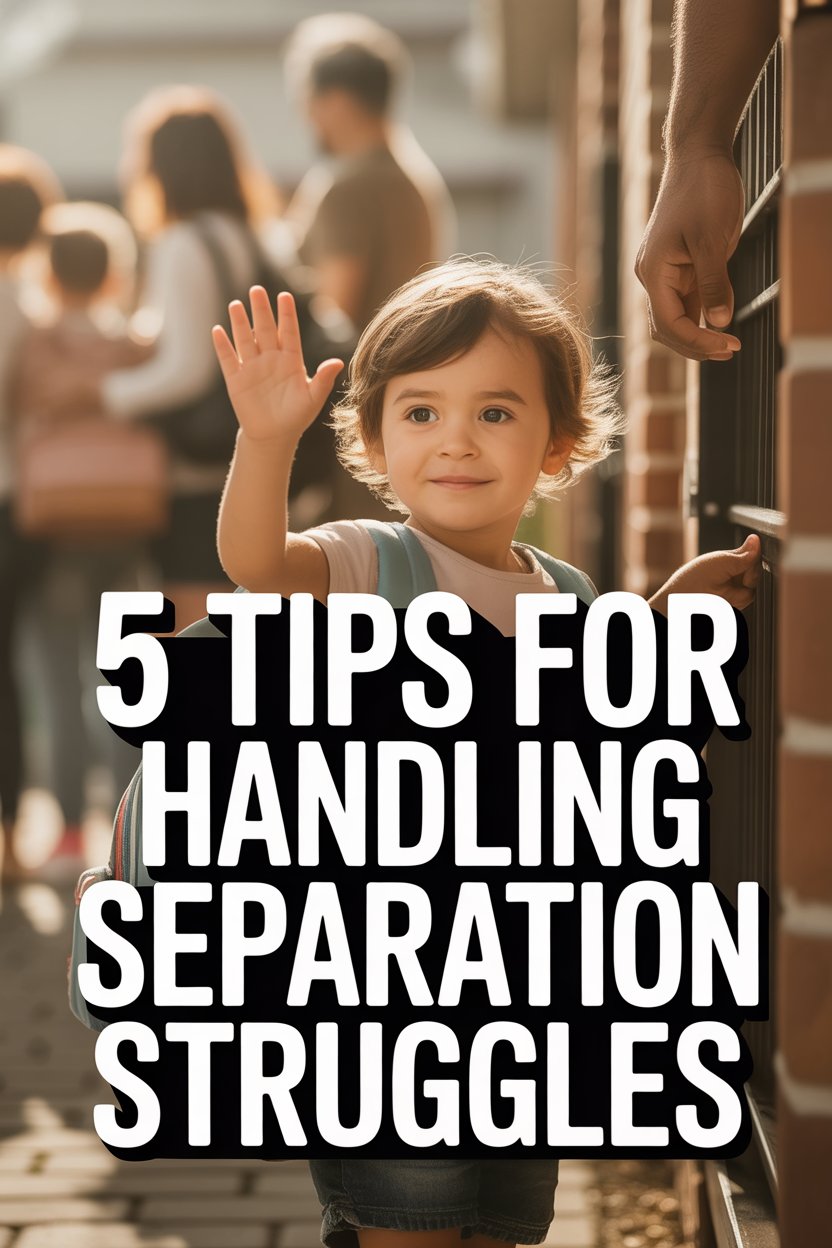
Separation struggles: every parent’s initiation rite.
Whether it’s the first day of nursery, a clingy farewell at the school gate, or the moment you attempt to sneak out for a much-needed coffee alone, that tidal wave of emotion—teary eyes, lip wobbles, the Velcro grip of tiny hands—can leave you questioning your very sanity.
But take heart, because with a few tweaks and tricks, those tearful goodbyes can become a whole lot less dramatic (and maybe, just maybe, you’ll make it out the door with your dignity intact).
1. The Power of a Predictable Goodbye
Children thrive on routine. It’s comforting, like their favourite blanket, only less likely to end up in the washing machine every other day.
When goodbyes are predictable, the world doesn’t feel quite so topsy-turvy.
A consistent farewell ritual—be it a secret handshake, a silly wave, or a whispered “I love you, see you soon”—gives kids a sense of control over the transition.
The predictability helps them trust that you’ll always come back (even if you’re just popping out to bin rubbish).
Researchers often highlight the benefits of routines for children’s emotional regulation.
A study in the Journal of Child Psychology and Psychiatry found that children with consistent routines showed fewer anxiety symptoms and adjusted better to change.
Keep it short and sweet, though. Lingering at the classroom door like an anxious meerkat usually ramps up the anxiety for everyone.
Say your chosen goodbye, smile (even if you’re dying a little inside), and leave with purpose. Your confidence is contagious—even if your only plan is to sit in the car for five minutes and have a little cry.
2. Name the Feelings, Then Reassure
Tiny humans have big emotions, and often, even bigger confusion about what’s going on inside their heads.
Is that sadness? Fear? The overwhelming urge to glue themselves to your leg? Sometimes, it’s all three.
Giving a name to their feelings does wonders. You might say, “You look sad that I’m leaving. It’s hard to say goodbye.”
This simple act of labeling emotions helps children feel heard and less alone with their stormy thoughts.
Dr. Daniel Siegel, co-author of The Whole-Brain Child, suggests that when children’s feelings are acknowledged rather than dismissed, their brains process those feelings more effectively, leading to quicker recovery from distress.
Once you’ve named the feelings, offer calm reassurance. “I’ll be back to pick you up after story time. Grown-ups always come back.”
Avoid over-the-top promises—no child needs to hear, “Mummy will return at precisely 3:17pm after fighting off dragons.” Just enough information to soothe, not enough to raise suspicious eyebrows.
3. Keep Your Own Anxiety on a Tight Leash
Children are like little mood barometers. If you’re jittery, they’ll pick up on it faster than you can say “attachment theory.”
While it’s perfectly normal to feel a pang (or, let’s be honest, a full-on pangalicious meltdown) when leaving your little one, try not to broadcast those fears with your body language or voice.
Fake it till you make it is the name of the game here. Put on your best “this is totally fine” face.
Smile, maintain an upbeat tone, and stand tall—even if your inside voice is screaming, “This is a disaster!”
A recent study from the University of Wisconsin-Madison found that parents’ stress and anxiety can transfer to their children biologically, making the case for a little self-care before drop-offs.
Whether you like to meditate, power-walk, or lock yourself in the loo for a quick breather, take a moment for yourself before the big goodbye.
Worried you’ll crumble? Practice your goodbye with another adult or, if you’re feeling brave, in the mirror. No judgment from that toothpaste-spattered reflection.
4. Give the Child a Role or Job
Kids love to feel important. One clever way to ease separation is to give them a “special job” to do while you’re apart.
Assign a mission: “Can you draw me a picture while I’m gone?” or “Will you help your teacher put the books away today?”
This shifts their attention away from the drama of leaving and towards something constructive. It also reinforces their sense of competence and independence.
Psychologist Dr. Laura Markham, author of Peaceful Parent, Happy Kids, suggests that giving children responsibility helps them build confidence and resilience, making transitions smoother over time.
If your child is old enough, let them choose the task themselves. Sometimes the job might be “guarding your seat until you return”—a serious business for a four-year-old.
5. Use Transitional Objects (and Don’t Be Afraid to Get Creative)
The world is a scary place when you’ve only just worked out how to put your shoes on the right feet.
A transitional object—a beloved teddy, a family photo, a special bracelet—can help bridge the gap between home and wherever you’re going.
Research on attachment, including studies from Harvard University’s Center on the Developing Child, has highlighted the soothing effects of familiar objects during stressful separations.
These items work as stand-ins, offering comfort until you’re back in each other’s arms.
If school or nursery bans toys (sometimes they do, cruelly), try a “kiss note” in a coat pocket, or a spritz of your perfume on their sleeve.
One mum swears by giving her daughter a “magic button” (just an ordinary button, but don’t tell her that) to squeeze for courage.
Just don’t forget to label everything. Losing Mr. Snuggly on the first day out is the sort of trauma that keeps family therapists in business.
When the Tears Keep Flowing
Perseverance is key.
Some children breeze through separations like they’ve been practicing for years. Others take a bit longer, and that’s perfectly normal.
If your little one turns every parting into a Shakespearean tragedy for weeks on end—keep the faith. Stick with your routines, listen to their feelings, and trust that, with time, confidence will blossom.
And mums and dads? If you need a little something for your own separation sadness, don’t underestimate the healing powers of a hot cuppa and the knowledge that you’re absolutely not alone.
Every parent in the pick-up line has probably wept in their car at least once. Maybe twice.
Eventually, those tearful goodbyes turn into casual waves. One day, they might even barrel through the door without a backward glance.
Don’t worry, they’ll still need you—for laundry, snacks, and the occasional existential crisis.
But probably not for holding your leg at drop-off forever.