Ever feel guilty your toddler can’t recite the alphabet backwards while balancing on one foot? You’re not alone.
Somewhere between flashcards and phonics apps, parents got the idea that academic skills rule supreme—even before school begins.
But the truth is, a child’s best classroom is play. And the skills they build there? Those are the real game-changers.
Forget the pressure to raise a baby Einstein. It’s time to spotlight the unsung play skills that outshine rote memorization and letter drills—skills that set the stage for lifelong success (and save your sanity at playgroup).
1. Imagination Station
If you’ve ever watched a preschooler turn a cardboard box into a spaceship (or, more likely, a “snack cave”), you’ve witnessed the mind’s most dazzling muscle at work: imagination.
Make-believe play isn’t just adorable. Psychologists at the University of Cambridge discovered that children who engage in pretend play show greater emotional understanding and empathy.
That means when your little one hosts a tea party for dinosaurs, they’re learning how to see the world through someone else’s eyes—even if that someone is a triceratops called Dave.
Imagination also fuels problem-solving and innovation. Kids who invent rules, roles, and stories are the future adults who dream up better ways to fix leaky taps, run companies, or survive Monday mornings.
How to nurture this? Leave plenty of time for unstructured play, put away the how-to-draw books, and let your child lead.
Bonus points if you accept an invitation to become the dragon in their medieval adventure—no costume required.
2. Negotiation and Turn-Taking
It’s all fun and games until someone wants the same toy truck. And the other someone has absolutely zero interest in waiting their turn.
Welcome to the earliest lessons in negotiation—a skill no flashcard can teach. The back-and-forth of sharing, trading, and “that’s not fair!” is the playground equivalent of a United Nations summit.
Kids learn to read facial cues, compromise, and—sometimes—walk away when things get heated.
According to the Harvard Center on the Developing Child, developing social skills like negotiation in early childhood lays the groundwork for emotional intelligence, self-control, and resilience.
How do you support this, besides hiding the prized truck? Try not to jump in at every squabble. Stay close, but let young children work through their disagreements.
If mediation is needed, help them put feelings into words—“You’re both frustrated. What can we do?”—and resist the urge to referee every minor injustice.
3. Risk-Taking and Resilience
Picture this: a muddy puddle, a wobbly climbing frame, a child poised to leap. Cue the parental heart palpitations. But here’s the thing—safe risk-taking during play (not juggling knives, mind you) is the secret sauce to building grit.
Children who climb, jump, tumble, and try again after a fall are practicing resilience.
A study published in the Journal of Adventure Education and Outdoor Learning found that kids given opportunities to take measured risks develop stronger problem-solving skills and greater confidence.
Resist the urge to wrap your child in bubble wrap. Instead, scope out safe spaces—playgrounds with fall-friendly surfaces, back gardens with soft grass—and cheer them on.
Celebrate effort, not just success. “You tried climbing higher than yesterday!” goes much further than “Careful!” squeaked every two seconds.
4. Self-Regulation in Action
Ever seen a toddler lose all composure because their biscuit broke in half? Self-regulation is what helps a child go from meltdown to ‘meh’—and play is the perfect training ground.
Games with rules—Simon Says, Duck Duck Goose, or even a rowdy pillow fight—teach kids to manage impulses, wait their turn, and handle winning (or losing) gracefully.
A large-scale study showed that strong self-regulation in the early years predicts not just better academic achievement later on, but also improved mental health and social skills.
You don’t need fancy board games or expensive “calm down kits.” Simple games that require stopping, starting, or pausing (think red light/green light) are enough.
If your child struggles with losing, empathize (“It’s tough not to win—we all feel that sometimes”) and model taking deep breaths or trying again.
5. Curiosity and Independent Exploration
Some days, keeping a curious child entertained feels like feeding a bottomless pit. But that endless stream of “Why? Why? Why?” is pure gold.
When kids poke, prod, and experiment, they’re teaching themselves how to think.
The American Academy of Pediatrics champions open-ended play as the best way to support children’s natural curiosity.
This sort of play encourages investigation, persistence, and intrinsic motivation—qualities every future scientist, artist, or inventor needs.
Instead of supplying all the answers, try responding with “What do you think will happen?” or “Show me how you figured that out.” Offer materials for exploration—blocks, sticks, pots and pans, whatever’s handy.
Stand back, sip your cuppa, and marvel at their discoveries.
Beyond ABCs—The Real Building Blocks
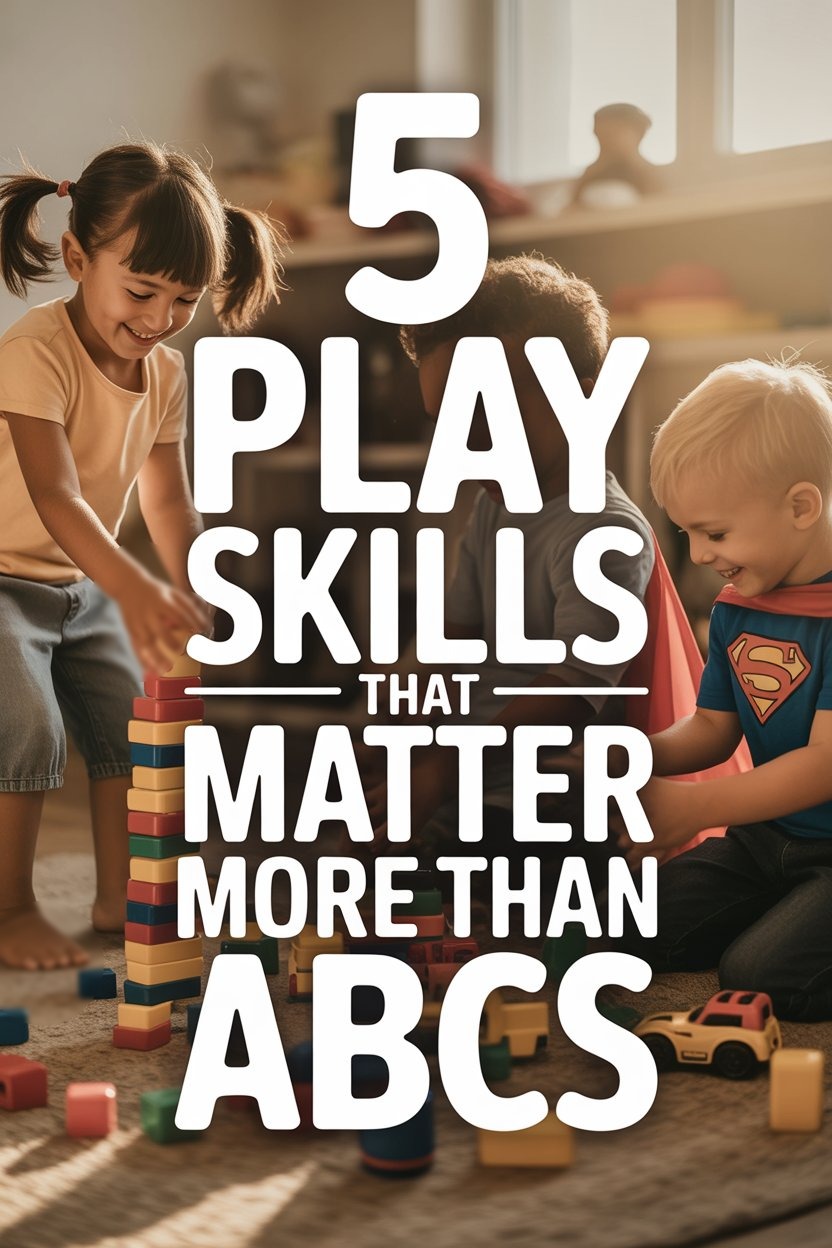
Letter recognition can wait. What really matters in the early years is play that lets children test ideas, stretch their imaginations, and figure out the messy business of being human.
The skills built through play—imagination, negotiation, resilience, self-regulation, and curiosity—will serve your child long after the alphabet song grows old.
The next time guilt creeps in about skipping alphabet drills, remind yourself: you’re doing the important work.
Whether you’re building cushion forts together, supervising garden mud pies, or just giving your child space to make up their own fun, you’re laying the foundation for smart, kind, creative adults.
And if someone else’s child recites the alphabet backwards at playgroup? Clap politely.
Then go home and have a dinosaur tea party. Dave the triceratops awaits.